Introduction
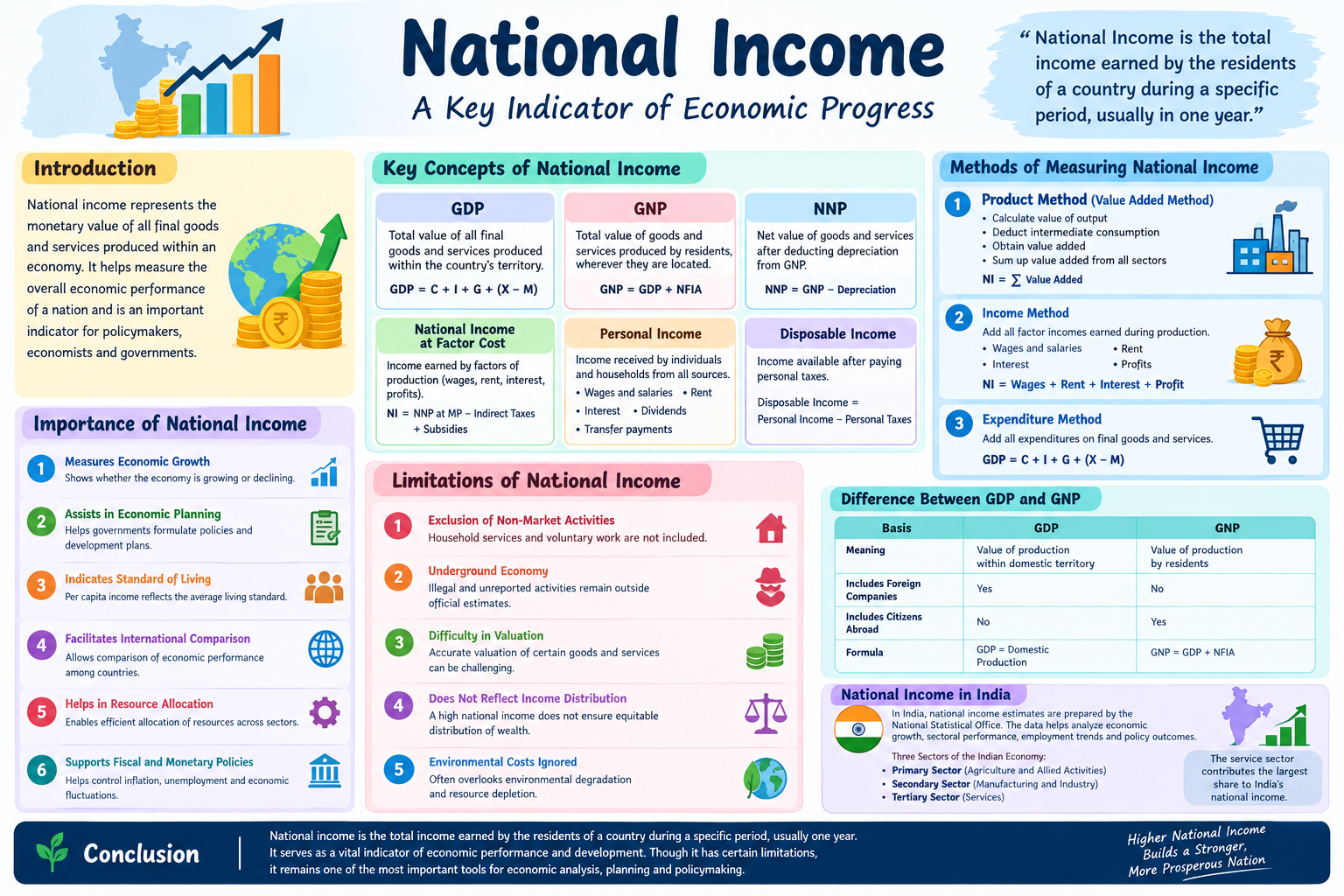
National Income is the total income earned by the residents of a country during a specific period, usually in one year. It represents the monetary value of all final goods and services produced within an economy and helps measure the overall economic performance of a nation.
National income is one of the most important indicators used by economists, policymakers, and governments to assess economic growth, living standards, and the effectiveness of economic policies. A rising national income generally indicates economic progress, while a declining national income may signal economic problems.
Meaning of National Income
National income refers to the aggregate earnings of all individuals, businesses, and other productive entities within a country during a given period. These earnings include wages, salaries, rent, interest, and profits generated from economic activities.
In simple words, national income measures the flow of income generated by the factors of production—land, labor, capital, and entrepreneurship—in an economy.
Key Concepts of National Income
To understand national income properly, it is important to know its major concepts.
1. Gross Domestic Product (GDP)
Gross Domestic Product (GDP) is the total market value of all final goods and services produced within the domestic territory of a country during a year.
GDP includes production by both residents and foreign entities operating within the country.
Formula:
GDP=C+I+G+(X−M)GDP = C + I + G + (X – M)
Where:
- C = Consumption expenditure
- I = Investment expenditure
- G = Government expenditure
- X = Exports
- M = Imports
2. Gross National Product (GNP)
Gross National Product (GNP) is the total value of all final goods and services produced by the residents of a country, irrespective of where they are located.
Formula:
GNP=GDP+NetFactorIncomefromAbroad(NFIA)GNP = GDP + Net Factor Income from Abroad (NFIA)
3. Net National Product (NNP)
Net National Product (NNP) is the net value of goods and services produced after deducting depreciation from GNP.
Formula:
NNP=GNP−DepreciationNNP = GNP – Depreciation
4. National Income at Factor Cost
National Income at Factor Cost refers to the income earned by factors of production in the form of wages, rent, interest, and profits.
Formula:
National Income=NNP at Market Price−Indirect Taxes+SubsidiesNational\ Income = NNP\ at\ Market\ Price – Indirect\ Taxes + Subsidies
5. Personal Income
Personal Income is the income actually received by individuals and households from all sources.
It includes:
- Wages and salaries
- Rent
- Interest
- Dividends
- Transfer payments
6. Disposable Income
Disposable Income is the income available to individuals after paying personal taxes.
Formula:
Disposable Income=Personal Income−Personal TaxesDisposable\ Income = Personal\ Income – Personal\ Taxes
This income can be used for consumption and savings.
Methods of Measuring National Income
National income can be measured using three major methods.
1. Product Method (Value Added Method)
Under this method, the value of all final goods and services produced in different sectors of the economy is calculated.
Steps:
- Calculate the value of output.
- Deduct intermediate consumption.
- Obtain value added.
- Sum up value added from all sectors.
Formula:
National Income=∑Value AddedNational\ Income = \sum Value\ Added
2. Income Method
This method measures national income by adding all factor incomes earned during production.
These incomes include:
- Wages and salaries
- Rent
- Interest
- Profits
Formula:
National Income=Wages+Rent+Interest+ProfitNational\ Income = Wages + Rent + Interest + Profit
3. Expenditure Method
Under this method, national income is measured by adding all expenditures made on final goods and services.
Formula:
GDP=C+I+G+(X−M)GDP = C + I + G + (X – M)
This method focuses on total spending within the economy.
Importance of National Income
National income plays a crucial role in economic planning and development.
1. Measures Economic Growth
National income helps determine whether the economy is growing or declining over time.
2. Assists in Economic Planning
Governments use national income data to formulate economic policies and development plans.
3. Indicates Standard of Living
Per capita income, derived from national income, provides an estimate of the average standard of living of people.
4. Facilitates International Comparison
National income statistics allow comparison of economic performance among different countries.
5. Helps in Resource Allocation
Governments can allocate resources more efficiently by analyzing sector-wise contributions to national income.
6. Supports Fiscal and Monetary Policies
National income data assists policymakers in controlling inflation, unemployment, and economic fluctuations.
Limitations of National Income Measurement
Despite its usefulness, national income has certain limitations.
1. Exclusion of Non-Market Activities
Household services and voluntary work are generally not included in national income calculations.
2. Underground Economy
Illegal and unreported economic activities remain outside official estimates.
3. Difficulty in Valuation
Accurate valuation of certain goods and services can be challenging.
4. Does Not Reflect Income Distribution
A high national income does not necessarily indicate equitable distribution of wealth.
5. Environmental Costs Ignored
National income calculations often overlook environmental degradation and resource depletion.
Difference Between GDP and GNP
| Basis | GDP | GNP |
|---|---|---|
| Meaning | Value of production within domestic territory | Value of production by residents |
| Includes Foreign Companies | Yes | No |
| Includes Citizens Abroad | No | Yes |
| Formula | GDP = Domestic Production | GNP = GDP + NFIA |
National Income in India
In India, national income estimates are prepared by the National Statistical Office. The estimates help the government analyze economic growth, sectoral performance, employment trends, and policy outcomes.
The Indian economy is broadly divided into three sectors:
- Primary Sector (Agriculture and Allied Activities)
- Secondary Sector (Manufacturing and Industry)
- Tertiary Sector (Services)
Among these, the service sector contributes the largest share to India’s national income.
Conclusion
National Income is the total income earned by the residents of a country during a specific period, usually one year. It serves as a vital indicator of economic performance and development. Concepts such as GDP, GNP, NNP, personal income, and disposable income help economists understand different dimensions of economic activity. Although national income measurement has certain limitations, it remains one of the most important tools for economic analysis, planning, and policymaking. A proper understanding of national income enables governments and citizens to evaluate economic progress and work toward sustainable development.
Apne Career ko Digital Duniya ke Liye Ready Karo! 
Aaj ke time mein Digital Skills sirf ek option nahi, balki zaroorat ban chuki hain. Agar aap Digital Marketing, Graphic Design, Web Development ya AI Tools jaise in-demand skills seekhna chahte hain, to Vidya Sarthi Institute of Digital Education, Faridabad aapke liye sahi jagah hai.
 Practical Training Industry-Oriented Courses Expert Mentors Placement Assistance Live Projects & Hands-on Learning
Aaj hi apni learning journey shuru karein aur apne sapno ko digital success mein badlein.
 Enquiry ke liye abhi contact karein!
 Vidya Sarthi Institute of Digital Education, Faridabad
“Skill Seekho, Career Banao, Future Ko Digital Banao!”